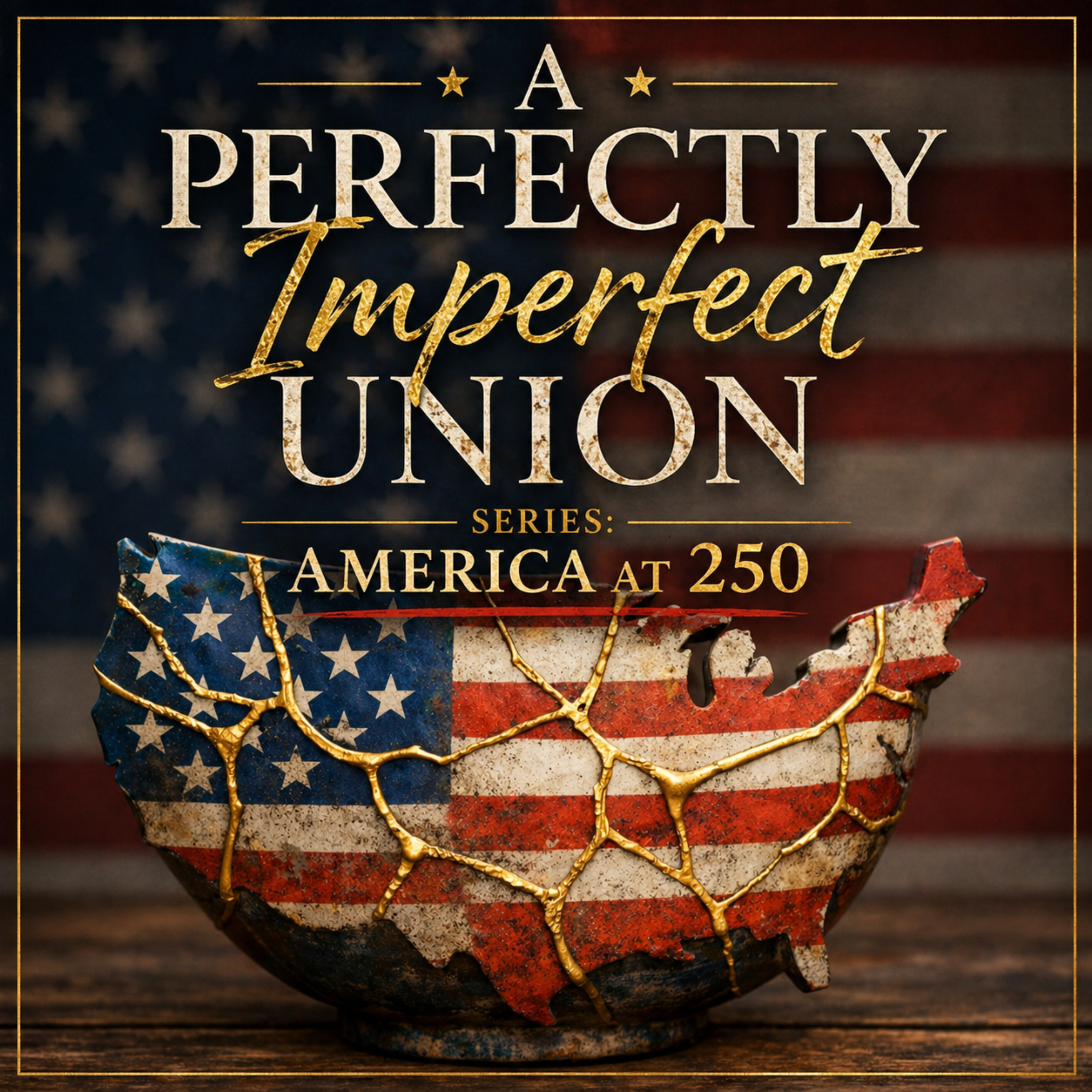
A Perfectly Imperfect Union: Reflecting on America 250 with John Dye
The Whole Again Podcast: Mindfulness and Resilience through Kinstugi Wisdom airs every Monday, Wednesday and Friday with Pause Breathe Reflect Microdose Meditations, Growth Mindset and Mindfulness Tips, to help us transform our scars into healing and resilience.
And between May and October, I'm sharing a new series I'm calling: A Perfectly Imperfect Union. It's about connecting with every day folks as they reflect on America at 250. Conversations will air every Tuesday, Thursday and Saturday.
-------
What does it mean to keep becoming, even when the road isn't a straight line up?
I recently sat down with John Dye on our Perfectly Imperfect Union Series. He works at the intersection of faith and media, trying to make culture a little more faith-fluent and a little more curious about difference.
He sees America not as a melting pot, but a big salad bowl. Different ingredients, still distinct, still whole, sitting right next to each other and somehow making something better together.
He talks about empathy as the glue, about having bigger ears than mouths, and about a thing called the human library, where you can sit down with a stranger and check out their story like a book.
His wish for the country is that it keeps becoming, unevenly, imperfectly, but always moving toward more freedom and more room for people to be different and still belong.
And his question for you and our next guest is:
What are the three most important characteristics you see in others that you'd like to adopt, for yourself or for society as a whole?
Share your thoughts in the comments and share this episode with someone you love.
You can discover more about John via LinkedIn.
You can now download my Pause Breathe Reflect App with Microdose EQ for FREE on Apple’s App Store or Google Play. Discover how to spend less time on your phone and more time on things that bring you joy. Also, find the support you need to navigate today’s uncertainty with more calm and grace.
Receive a FREE copy of my book: “My Last Bad Day Shift.”
We can also connect on LinkedIn.
Subscribe to be sure you don’t miss any of the micro-meditations, wellness tips, and guidance that I publish every Monday, Wednesday, and Friday at 7:11 am.
<p> Hey there. It's Michael. Welcome to Whole Again, the show that's here in support of you creating a meaningful life and the person you're becoming. And I'm excited to share a new series with you that will air this summer as America turns 250 years old, which is still pretty young relative to many other countries across this big blue marble that we all share.</p>
<p></p>
<p>The series is called A Perfectly Imperfect Union. In 2022, I rode my bike across America from Astoria, Oregon, to the Lincoln Memorial. My wife drove our RV, and she had two co-pilots, Jester and Hope, two springer spaniels And when we did it, America was coming out of the pandemic, and we were hurting.</p>
<p></p>
<p>Hurting from things that had happened prior to the pandemic. Of course, going through what we all went through. And at that time, and this is something I still believe today, is that we were entering an inflection point. An inflection point for us to hopefully pause, breathe, and reflect on who we wish to become as individuals, as communities, and as a country.</p>
<p></p>
<p>As I pedaled across America, I wanted to share America's beauty with others, her natural beauty and the beauty of her people. And I also wanted to share where we were hurting As America turns 250, I believe Kintsugi, which is something we use as a metaphor here at Whole Again, is a perfect metaphor for where we are as a country.</p>
<p></p>
<p>There's so much beauty to celebrate, and we can also acknowledge that parts of us feel broken or are broken. But we can find a way to come back together, just like Kintsugi teaches us. And when we do, we don't try to erase or cover up where we have scars or blemishes. We highlight them in gold, and we celebrate them as symbols of our strength and resilience.</p>
<p></p>
<p>Kintsugi is called the golden repair, and in essence, we can see beauty in something that's perfectly imperfect. During this series, I plan to speak to at least two people in each state and the District of Columbia, so 102 conversations with real folk, as I like to say. We're gonna let the celebrities and the big influencers have their day somewhere else.</p>
<p></p>
<p>But here, I wanna reach out and talk to real people and listen to their reflections as they think about America turning 250 years old. And my hope is, is that you'll tune in to at least one, if not all 102, 'cause my theory going into this is that you'll hear different perspectives. Some may be aligned with yours, others may not.</p>
<p></p>
<p>But my hope is that you hear the goodness in your fellow citizens and realize, as Maya Angelou shared with us, "We are more alike, my friends, than we are unalike." We are more alike, my friends, than we are unalike. I've had the privilege of traveling all over the world and all over this country, and this belief is something that I hold deep inside of me.</p>
<p></p>
<p>So yes, I do believe that we are more alike, my friends, than we are unalike So if you're ready to get to know one of your fellow neighbors, take a healthy breath in and a slow releasing breath out, and get to know John Dye. And with my conversation with John, I wanna give you a heads-up. We had a bit of a tech kerfuffle.</p>
<p></p>
<p>We were recording on one platform, and we had to switch to Zoom, so we lost the first couple of minutes of our conversation. But I think you can catch up and really enjoy John's perspective as America turns 250.</p>
<p></p>
<p>All right. I just- There you are </p>
<p></p>
<p>Yep, we're back. </p>
<p></p>
<p>We're back. We're back. Look at that. We can- </p>
<p></p>
<p>How does that sound? Does that sound okay? </p>
<p></p>
<p>That sounds great. Can you hear me okay? </p>
<p></p>
<p>Yes. Yes, </p>
<p></p>
<p>yes. Perfect. Well, as I mentioned before we had a little technical kerfuffle, we as humans can do hard things, and we were talking about your upbringing from Montana to Idaho, some time in Taiwan, and now Utah, and just the natural diversity and beauty of Utah, which, uh, I think is absolutely fantastic.</p>
<p></p>
<p>I so enjoyed my time. I've only been to Utah a couple times, but each time I go, I, again, I'm just mar- I marvel at what Mother Earth and God and the universe have, have created there. So it's so cool. </p>
<p></p>
<p>Yeah. Yeah, it's this convergence of otherworldly red rock with the beauty of the mountains and the, uh, the, the, the great and spacious trees, um, just up north.</p>
<p></p>
<p>So yeah, it's beautiful. It's, it's a, it's a wonderland, that's for sure. </p>
<p></p>
<p>Absolutely. So let's say you're in one of those special pla- uh, places in Utah. You have your friends and family all around you, maybe some colleagues, and you get talking about America turning 250, and someone will ask you, "Hey, John, what does America mean to you?"</p>
<p></p>
<p>How do you respond to them? </p>
<p></p>
<p>You know, it's, it's interesting. I grew up, as we mentioned before, in Montana. I was a Boy Scout, loved obviously my time as, as a Boy Scout, and, um, obviously one thing that taught me was respect and, um, reverence for the Founding Fathers, for the country, for the Constitution, the basic documents that set up this republic and this great experiment that we're still now 250 years trying to figure out and trying to, trying to perfect.</p>
<p></p>
<p>Um, you know, what it means to me, though, is this: I love the pluralistic nature of America. I believe that's something that we've all inherited, right? At some point, we can point to an ancestor or, and/or a group of ancestors that had to come to America. I- I have 2% Native blood in me. Well, at some point, they came from somewhere to arrive here as well, right?</p>
<p></p>
<p>So I love the pluralistic, uh, way that we have traditionally accepted immigrants, that we have war- uh, welcomed them warmly into our country, have helped them, um, become citizens, right? And stand on their own two feet. And a- again, I don't wanna make this too political, but from an immigration perspective, I, I love the fact...</p>
<p></p>
<p>I, I think you should enter through the front door. Let's, let's do this legally. But I think we should be welcoming people in because they are the lifeblood and the oxygen of America. They create the, the wonderful, um, uh, salad bowl, so to speak, that is America. You know, you go to New York City, you even go to LA, and you have Koreatown and Chinatown and all these different areas where people come together, and they're bordering on one another, and they have their homogenous culture, but it's right next to somebody else, and you get these fusions of wonder and beauty.</p>
<p></p>
<p>So that, that is one thing that I love. </p>
<p></p>
<p>I love that analogy of a, a big mixed salad because you have, like, all the different... You have, like, the tomatoes and the cucumbers and the avocado and the sunflower seeds and the romaine lettuce and everything else you can put into a beautiful salad, as opposed to the melting pot analogy that we grew up, at least I grew up with listening to, uh, Schoolhouse Rocks.</p>
<p></p>
<p>You know, it's like, you know- </p>
<p></p>
<p>Yes. </p>
<p></p>
<p>Yes ... we all become the same. But really, it's like, as you point out, it's like our differences- Yeah ... have, like, that really make this beautiful tapestry known as America. And yeah, there, there's certainly a better way to Have a immigration system or a process. You know, I think wherever you might sit politically, we could probably all agree that it could work better, right?</p>
<p></p>
<p>Yeah. So- </p>
<p></p>
<p>Yeah, absolutely ... </p>
<p></p>
<p>so you mentioned a little bit of your heritage. Your, the, your, uh, 23andMe, which I guess now is a defunct company, but do you know much about your family's origin story here to this land in America? </p>
<p></p>
<p>You know what? I, I do. Um, if you go back to the old land, um, you know, I have Irish heritage.</p>
<p></p>
<p>Uh, Butte, Montana is where my mom's from, and that's- Okay ... you know, they emigrated from Ireland and became miners- Yeah ... and there were great things happening during the, the copper days of Marcus Daly. Um, and my dad, I'm a bit of a mongrel, right? I, I guess- Yeah ... if you go back far enough, all of us are. But- Oh, yes</p>
<p></p>
<p>um, Scotland, northern England, Wales, those areas. But, um, uh, yeah, so, so a lot came over from, from the old country. Um, some, some of them started, uh, well, obviously New York City was, was huge for a lot of them- Yeah ... when they first entered- Yes ... the country. Um, I had some that came from the west, or excuse me, from the east to the west, and some from California, and, and had to, you know, eventually ended up residing in, in Montana, my home state of Montana.</p>
<p></p>
<p>But yeah, various... It, it's very interesting to me though to note how, and, and I believe God's hand is in many of the happenings in our lives. Um, many of these individuals, um, were homesteaders, and because of natural disasters, right, they were pushed a certain way to, c- crops failed or, you know, couldn't subsist based on what they were able to, to do based on the land, et cetera.</p>
<p></p>
<p>So, um, it's, it's funny to see how all of this, these variables come together to create what is my life and my siblings' life, and we're now creating progeny and yeah, it's just a, a, a various, uh, it's a long story that is, is still being written. </p>
<p></p>
<p>Yeah, I know. I, I love it. Thanks for sharing that with the, some of the, that Irish blood in you and, and the m- the miner Profession, you know, that's sort of the origin story of the luck of the Irish, you know, when the- </p>
<p></p>
<p>Yes</p>
<p></p>
<p>Irish moved west and started mining in places like Montana, of course, the gold rush in California. A lot of the experienced miners were like, "Oh, that's just the luck of the Irish." Although discounting how much hard work they were putting into their craft, it was really hard work, and a lot of hard work has helped, um, build this country, uh, no doubt.</p>
<p></p>
<p>And we seem to be, like, doing a lot of hard work or a lot of hard thinking around AI these days. You know, I can't escape a day without some type of interaction with it or a conversation or a prediction as far as what it will do and what it won't do. So this is a little bit of a time capsule. I might go back and listen to these 25 years, you know, you know, in the future, look back and see, like, how did we all think about AI?</p>
<p></p>
<p>But where, where do you stand current day here in 2026? Where do you, where do you think AI is taking us? </p>
<p></p>
<p>Yeah, AI is interesting to me. Um, and again, I'm highly influenced by religious figures, the encyclical that, uh, the Pope just came out with. And, uh, my own faith tradition, there's somebody named Garrett Gong, Elder Garrett Gong, who recently came out with some videos I think that are really important.</p>
<p></p>
<p>Uh, the, the key thing for AI, because it again, it has been so blazing fast, what November of 2022 or whenever- Sure ... you know, I first was introduced to it to now sitting in June of 2026, um, the things that it can do are just blind- mind-blowing. My feeling is this: anything that... Well, my, my, my personal feeling is God created man, man created AI.</p>
<p></p>
<p>AI is not God, and it never can be. </p>
<p></p>
<p>Yeah. </p>
<p></p>
<p>Um, right? But, but there are many things that it can do to help us become much more efficient at what we're doing. Um, you know, we used to talk about virtual assistants that you could hire to do certain- Yeah ... key things behind the scenes. Right now, those can be agentic.</p>
<p></p>
<p>Those can be bots. Um, I also believe that, um- W-we cannot use it to shortcut things that only we can do as humans. Meaning, um, we can't allow it to learn for us. We've still gotta put in the blood, sweat, and tears to figure things out, and it, it can help with, with some of the process, but it, it should not be the process, I guess is what I'm saying.</p>
<p></p>
<p>So, um, how can we leverage it to make it, make us more efficient as human beings? And I'd say get rid of the dross of our lives that sometimes we have to do, right? That you, you have to jump in the trenches and get done. Well, if it can do it better than us, that's great. But if we're talking about, uh, key things, spiritual things, key things from a learning perspective, educational perspective, it can help create some of the shortcuts that are good, but we shouldn't let it circumvent some of the things that make us better and more human individually.</p>
<p></p>
<p>Yeah. So we can see it as what I hear in your answer, John, is like see it as a very useful modern-day tool, much like some of the tools of the past. Yes. But please don't forget that we're human and we gotta lean into the things that make us human so we have greater connection. Uh, if we don't lean into that, if we're not intentional about that, then yeah, we can, we might go down a completely different path when it comes to AI, right?</p>
<p></p>
<p>So, um- </p>
<p></p>
<p>Right. Right. We-- Yes, we would, we do not wanna live the future of, um, what, what was the Terminator, uh, system called? Anyway- Yes ... when, when technology took over, I can't remember the name of the company, but we don't want AI to become that. </p>
<p></p>
<p>Absolutely. Absolutely not. So we do talk also about how we're divided here in the country.</p>
<p></p>
<p>You know, people feel it. There's, I think, clear cases where we are. I used Kintsugi, the Japanese art form, as a metaphor for this series where, you know, something beautiful, a, a nice piece of pottery breaks, but we f-find a way to mend it. We highlight the You know, the connection points in gold and they become symbols, the golden repair, if you will, the symbols of our strength and resilience.</p>
<p></p>
<p>So if you could take like just approach one thing that could help us heal and connect and, and grow from that, maybe it's not a perfect job right off the start, but it's a good first step. What would it be? </p>
<p></p>
<p>You know, the biggest thing I think sometimes we lack as humans, obviously within the country, but even larger than that, is just empathy and having bigger ears than we have mouths.</p>
<p></p>
<p>Yes. Um, and, and I struggle with this personally, just ask my wife and, and kids. But, um, I, I think if we were to sit down and try to empathize and understand, truly listen and understand with individuals, whether that's based on gender, whether that's based on religion or faith tradition or spirituality flavor, whether that's based on ethnicity or skin color or all the differences that we can come up with, I think if we were to sit down and say, "You know what?</p>
<p></p>
<p>At the core, what brings us together is we're all human." Uh, in, in my belief, we're all sons and daughters of a loving God, right? Somebody who loves us, who has created us. We are creators ourselves, and as such, we, we have the power to, like you said, pull things together. And i- if we, if we don't listen, if we don't empathize, if we don't try to put ourselves in other people's shoes, I think not only, not only does it fracture our society, but we're lesser as an individual, as a person.</p>
<p></p>
<p>Because o- one of the r- reasons I love to read books is you get to absorb other people's experiences or perspectives or points of view. Um, there's something called the human library, if you look it up online. You can actually check an individual out like a book. Like you and I are talking one-to-one. Well, if I don't understand somebody of the Jewish tradition or somebody that came from Ethiopia, you can find people on the human library and set up a time to talk to them and ask them questions just like we're talking now.</p>
<p></p>
<p>Wow. I find that to be, I find that to be beautiful, to be able to, uh, discover somebody else, else's unique traits and characteristics based on a difference that they have, and not look at them with disdain or distrust, but with openness and with just this ability to be able to meld together and say, "What can I learn from you that I don't know because my own experience hasn't provided that for me?"</p>
<p></p>
<p>Yeah. The greater empathy, and I would say if we could all to just learn how to pump the brakes just a little bit, to slow down- Yes ... enough to take a breath, to then offer empathy and curiosity to learn from one another. When we're rushing to all the different places we seem to be rushing off to, there doesn't seem to be any time in the day to be empathetic.</p>
<p></p>
<p>So I love that you've, you've brought up this whole concept of empathy. Other people have brought it up, too. So it's really good that we're sort of coming together around this piece. I think people are feeling it, you know, given, like, all that we've gone through over the last, you know, 10, 20, 30 years to be able to, like, really, like, hear and see and, and love each other.</p>
<p></p>
<p>Uh, again, doubling down on what makes us human. So when we come to a birthday, John, nor- normally, m- most, most people love to have some cake, right? I'm, I'm not sure if you're a cake fan, but so th- this is a two-part question. What kind of cake are you serving for America's 250th birthday? And as you blow out the candles, what is your wish for the country?</p>
<p></p>
<p>Yeah. You know, growing up, I loved German chocolate cake. Oh. The coconut with the chocolate and- Yeah, </p>
<p></p>
<p>I </p>
<p></p>
<p>like that ... my, my mom just did it just- Oh ... chef's kiss. </p>
<p></p>
<p>All right. </p>
<p></p>
<p>Um, just beautifully. So I'll, I'll go with German chocolate, right? A little bit of that, uh, salad bowl analogy- Yes, I like that ... or analogy that we used before.</p>
<p></p>
<p>Um, and my one w- wish for America, I- I, I earlier mentioned that this was the great experiment, right? Not my word, not my term, but it's, it's something... There, there's something beautiful in the fact that something has been created, has momentum, is being optimized, but is never finished, right? And I think that's true of us as individuals from our birth date to our death date, right?</p>
<p></p>
<p>The dash is what matters. The dash. We've heard that. Yeah, absolutely. We are always becoming. We are always becoming. I think as a nation, we are becoming, and I, I think that road is not a slow trajectory up to a greater nation. Sometimes it's like this, right? Different administrations, different individuals, different epochs of history bring different things to, to, to our country.</p>
<p></p>
<p>I-- My, my greatest wish for the United States of America is that we continue to become. That even though we're doing this, right, uh, that eventually We are, we are leveling up, even though it might not be the slow trajectory up, it might be ins and outs, that we provide more freedom, we provide more individuality, we provide more uniqueness to the citizens because that is our greatest strength.</p>
<p></p>
<p>We, uh, unlike some of the, the, uh, if we, if we look back on history where sameness was focused on to the point of killing and to the point of, uh, doing things I think that history looks back on and say are some of the greatest massacres and, and worst tragedies in history, the beauty of what we have in our experiment is the fact that we are different.</p>
<p></p>
<p>We can identify sameness while recognizing uniqueness. And if we can do that, if we can, uh, truly show that empathy, if we can truly see that as the glue that holds us together, and one of our greatest strengths is what makes us unique, but we're all together, that is what I find to be beautiful. </p>
<p></p>
<p>I love that.</p>
<p></p>
<p>And, and we as humans, we can hold those two things at the same time, and I love the- Yes ... the whole rollercoaster waviness that you've made with your hands to talk about growth and who we are becoming as individuals and as a, as a community, as a culture, as a country. It's not so simple or simple. We don't walk a linear path to that person we're becoming.</p>
<p></p>
<p>It's messy, it's complicated, and leaning into all that is part of living a meaningful life. And so- Exactly ... this might be a softball question for you, given all the great work that you're doing, John, but I've asked the person I chatted with before you if they, um, have a question for you. And so this question comes from Bill from the great state of Texas.</p>
<p></p>
<p>So his question to you, and you get to ask a question of the person coming up. </p>
<p></p>
<p>Oh, good. </p>
<p></p>
<p>I like </p>
<p></p>
<p>it. </p>
<p></p>
<p>So Bill's question is this: Uh, what is something you're doing to better the people around you, making... Basically, in essence, what's one thing that you'd like to share where you're helping others create a better tomorrow?</p>
<p></p>
<p>Yeah. Beautiful. Thank you. That's a great question, Bill, and by extension, Michael. Um, service, I, I like to think service is part of my DNA. It's something that from a faith tradition perspective, uh, we feel very strongly about, and I personally feel very strongly about. Um, one thing that I'm involved in now, uh, i- is, is my day job that I think is, is going to help with, with future generations.</p>
<p></p>
<p>All right, cool. I work in something called Faith and Media, right? We look at the intersections of faith and media because basically we'd like to pivot culture. We wanna make it more faith fluent and more faith friendly, meaning, uh, if you're a Baha'i, we should treat those that are of that faith with respect.</p>
<p></p>
<p>If you're Christian, if you're Muslim, the same. A rising title of self votes. We're not just trying to say treat Christians better or treat Muslims better or Buddhists better. You know, let's, let's make Everyone more faith fluent, a more pluralistic society. We feel that's important. Now, how are we doing that?</p>
<p></p>
<p>Well, when we talk about media, it's usually entertainment, social media, and traditional journalism. 'Cause if, if you wanna really change the hearts and minds of people, a lot of that can be done through media. And so how do we make m- people more faith fluent and faith friendly through those, those terms?</p>
<p></p>
<p>Well, we are finding people that are in the media that have kept one foot firmly in their faith tradition, and the other foot, they've been very influential in their occupation. And we are identifying those individuals who can mentor the upcoming generation that cares about this. They can take what we consider the torch of, of truth or enlightenment.</p>
<p></p>
<p>Um, those younger individuals can stand on our shoulders, take that torch, and hold it up higher than y- we are today. Now, this is just one aspect, right? Uh, faith traditions, religion, spirituality. That's just one thing. It's something I feel very strongly about. But that could be said of anything that makes us different, and that's the beauty that I see is, um, there is...</p>
<p></p>
<p>It's this tapestry of, of beauty that comes together when you have all these people that believe something different but still see the value. And I call it, and other people have called it, again, not my word, holy envy, right? I'm, I myself consider myself Christian, but when I look at a Muslim, the way that they pray and that they worship, when I look at somebody who's Jewish, or like I said, Baha'i or, or other ways, I can learn something from every individual that has a different faith tradition that makes me a better adherent of my faith and a better disciple of Jesus Christ.</p>
<p></p>
<p>And when I do that, when I look at them with humility, when I look at them with inquisitiveness, with curiosity, and see what they're doing and say, "How can I utilize that in my life to make myself better?" I believe I become a better person overall. </p>
<p></p>
<p>All right. Well, thanks for sharing that. So what question do you have for the next neighbor I chat with in our series?</p>
<p></p>
<p>Oh, this is beautiful. I love the pay it forward, uh, or ask it forward </p>
<p></p>
<p>type- But it's a way that I </p>
<p></p>
<p>can get </p>
<p></p>
<p>everyone, I figure- Yeah ... </p>
<p></p>
<p>so </p>
<p></p>
<p>instead of just everyone connecting with me as, like, the host of the podcast, I wanna have a little bit of a red thread that connects all the different people I get to chat with- I love that</p>
<p></p>
<p>over the- I love that ... over the course of the summer. </p>
<p></p>
<p>I would say, I would ask them, "What are the three biggest characteristics or attributes of others That they see that they would like to adopt for themselves or for society as a whole. </p>
<p></p>
<p>All right. </p>
<p></p>
<p>What, yeah, what could, what could make them individually better, but us collectively better when they've noticed certain things happening that, uh, they wanna adopt on their, in their life, but also society, what we could adopt?</p>
<p></p>
<p>I love it. Well, during the next conversation in our series, I will ask that very question. And John, I wanna thank you for responding to that random LinkedIn message and agreeing to come on and sharing your ripple effect, and also just helping us become a more perfectly imperfect union. So, uh, I appreciate you, brother, and thanks for being here.</p>
<p></p>
<p>Hey, so good to see you, Michael. </p>
<p></p>
<p>Peace.</p>
<p></p>
<p>One of my mantras is that we can do hard things, and that includes when tech kerfuffles happen. So I'm really thankful, grateful that John was able to dance with me on this one as we switch from one platform to another. My hope is it wasn't too disruptive to you in the beginning. I just love what John shared and his perspective, and I would love to hear how you would respond to John's question about the qualities that you see in others that you would like our society to adopt as well.</p>
<p></p>
<p>Or you can share anything else that resonated from John's reflections as America now has turned 250 years old. And I hope you'll listen to the rest of the series as we march towards November and Election Day, and you'll check out an episode of Whole Again and share one or two of them with someone you know.</p>
<p></p>
<p>But until then, let's remember to celebrate our scars as golden symbols of our strength and resilience. And don't forget to have fun storming the castle.</p>
<p></p>
<p>And if you wish to learn more about creating beautiful ripples and how to prevent a bad moment from turning into a bad day, please visit my website, michaelobrienshift.com, and sign up for my newsletter called The Ripple Effect. And join us each Monday, Wednesday, and Friday here at Whole Again, and discover how you can heal, grow, and become more resilient, and celebrate our scars as golden symbols of strength and resilience.</p>
<p></p>
<p>Until then, remember, you can always come back to your breath. You've got this, and we've got you.</p>
 Apple Podcasts
 Castbox
 Castro
 Goodpods
 Moon FM
 Overcast
 Pocket Casts
 Podbean
 Podcast Addict
 Podcast Republic
 Spotify